
Buyers don’t purchase history. They purchase confidence in the future.
The Transferable Value Index is a business transferability assessment for closely-held business owners. Twelve questions, three to four minutes, scored on the two dimensions that decide whether a company can be sold: how durably it runs, and how independent it is from you. Take the assessment to see your score and quadrant on completion.
- Your Transferable Value Score — a 0–100 composite with quadrant placement, on completion
- Your dimension scores — Business Durability and Owner Independence scored separately
- A personalized analysis — written for your specific scores and quadrant
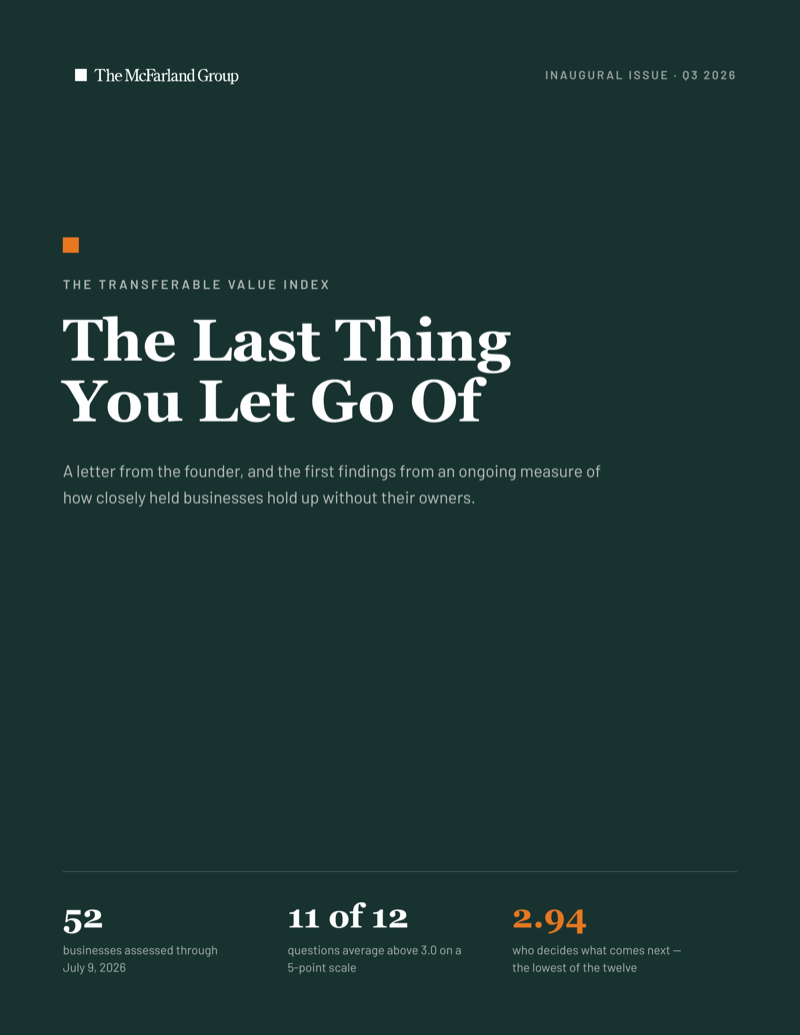
- The inaugural issue, The Last Thing You Let Go Of, out now. Download the PDF or subscribe to get each issue by email
- Published by
- The McFarland Group
- Advised transactions
- $3B+ in value
- Middle market
- 20+ years
Two dimensions most transactions treat as one.
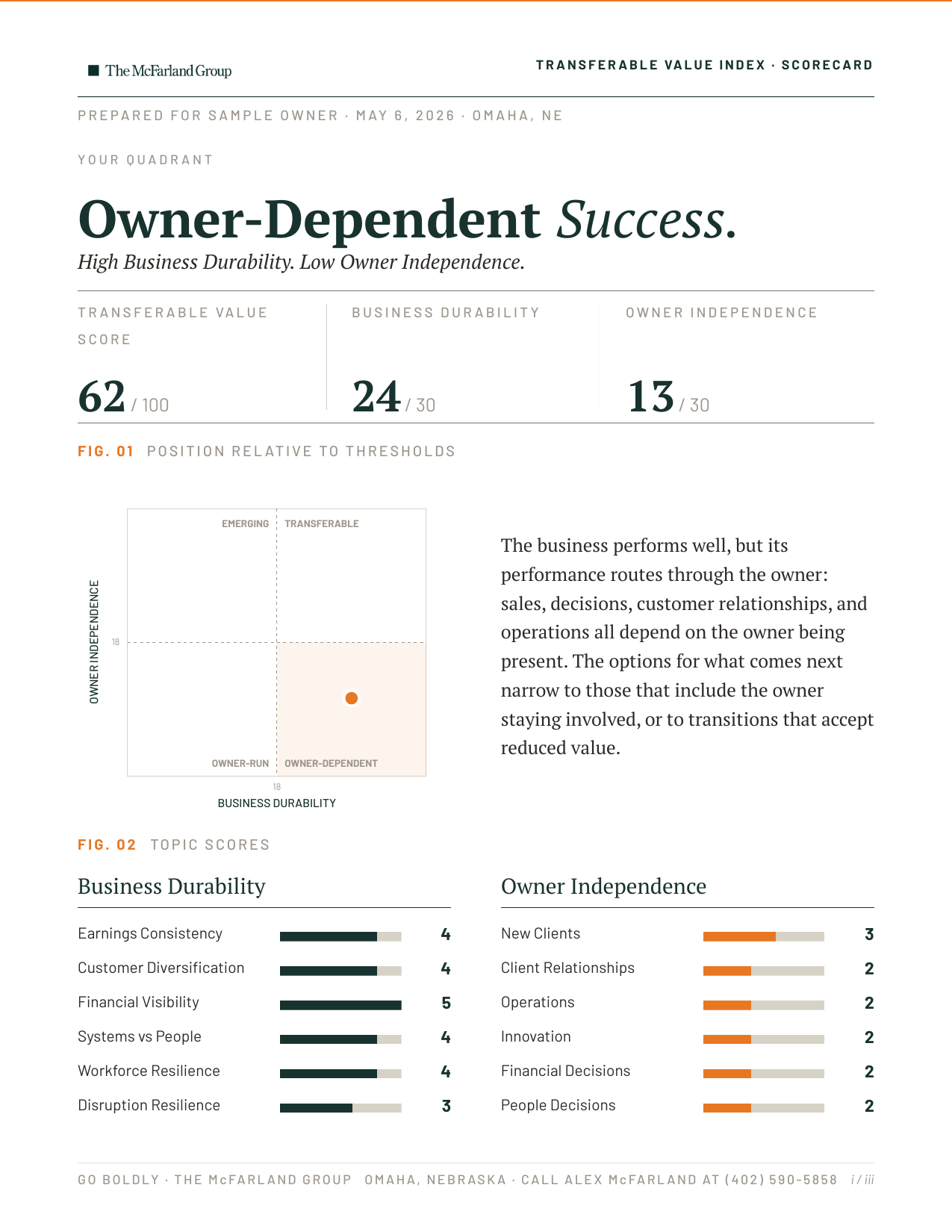
The Transferable Value Index evaluates closely-held owners across two axes plotted against a scoring threshold. Business Durability measures how structurally strong the company is. Owner Independence measures whether the company runs without you.
The team can run it. The durability needs to catch up.
Operations and leadership work without you. The earnings base is still proving itself. Two to three years of consistent results changes the picture.
Durable business. It runs without you.
This is the quadrant buyers and successors price most generously. A transition is viable on your terms.
Both axes need attention.
A transition is not the right next step. The work is in building durability and operating independence in parallel.
Durable business, but the owner is still load-bearing.
The company works. The transfer is precarious. Customer relationships, strategic decisions, or daily operations still route through the owner.
How structurally strong is the company?
Earnings consistency, customer diversification, financial visibility, systems versus key-person knowledge, leadership stability, and resilience to industry change. Questions 1 through 6.
Does the company run without you?
New-client acquisition, customer relationships, day-to-day operations, innovation decisions, financial decisions, and people decisions. Each measures how often work runs through the owner. Questions 7 through 12.
Most owners have built a strong business. The TVI surfaces whether that business runs without them, and where the gaps are if it does not.
Find out which quadrant is yours.
Three to four minutes. Your score and quadrant placement arrive on completion.
Three things, in this order.
The assessment takes three to four minutes. You receive three things immediately on completion, at no cost.
Your Transferable Value Score (0 to 100). A composite of how durable the business is and how much of it still runs through you.
See previewPlacement in one of four quadrants — Transferable Enterprise, Owner-Dependent Success, Emerging Enterprise, or Owner-Run Enterprise — with your dimension scores.
See previewA personalized written analysis of what your scores mean — specific to your quadrant, your dimension results, and the questions where your responses indicate the most opportunity.
Your scorecard, and the inaugural issue.
Two documents, produced to the same standard. Your scorecard is yours alone. The inaugural issue is out now, free to download.
Answer 12 questions. Get your Transferable Value Score and quadrant placement.
Three to four minutes. No cost.
Byron McFarland · Founding Principal, The McFarland GroupBuyers do not purchase history. They purchase confidence in a future the business can run without you. That confidence is transferable value. The work of becoming transferable is the work of stepping back. It is structural, gradual, and the difference between a business that sells well and one that does not.
We help you slow the moment down.
You are thinking through what comes next, whether that is a sale to management, a transaction with an outside buyer, or something in between. We work with owners like you. The goal is clarity, not pressure. Our approach is senior-led, calm, and structured.
The Transferable Value Index is a diagnostic instrument developed from The McFarland Group's advisory practice. It is the starting point for owners who want to understand where their business stands before entering a transition process.
The McFarland Group has guided more than three billion dollars in business value through ownership transitions over two decades. The firm works with owners in construction, manufacturing, and professional services on succession, structural preparation, and performance equity plans for key leaders.
The next step is knowing where you stand.
Take the assessment. See your score and quadrant today.
Common questions.
- What is the Transferable Value Index?
- The Transferable Value Index is a business transferability assessment for closely-held business owners. Twelve questions across two dimensions, Business Durability and Owner Independence, produce a composite score from 0 to 100 and place your company in one of four transferability quadrants.
- Who is the assessment for?
- The Transferable Value Index is built for owners of closely-held businesses, typically with revenue between $5M and $100M, who are starting to think about ownership transition. Construction, manufacturing, and professional services firms are a primary fit. The assessment is not designed for startups, VC-backed companies, or large enterprises with in-house M&A teams.
- How long does the assessment take?
- Three to four minutes. Twelve questions, scored 1 to 5 each. Your composite Transferable Value Score, dimension scores for Business Durability and Owner Independence, quadrant placement, and a personalized analysis arrive within thirty seconds of completion.
- What do I receive on completion?
- A personalized scorecard with your Transferable Value Score, your two dimension scores, your quadrant placement, and a written analysis specific to your scores. The Transferable Value Index quarterly publication arrives in your inbox if you subscribe.
- What are the four transferability quadrants?
- The four quadrants are Transferable Enterprise (high durability, high independence), Owner-Dependent Success (high durability, low independence), Emerging Enterprise (low durability, high independence), and Owner-Run Enterprise (low durability, low independence). Quadrant placement uses a cutoff of 17 to 18 raw points on each dimension.
Take the Transferable Value Index.
Twelve questions. Your score, quadrant, and personalized analysis on completion. No cost.
Begin the assessmentAlso receive the Transferable Value Index issue each quarter.